Welcome~Xi'an Taima Biological Engineering Co., Ltd.
+86 029 8111 0978

Neohesperidin Dihydrochalcone (NHDC) is known for its high-intensity sweetness, but its behavior in water is an important consideration during beverage formulation.
One practical question for formulators is whether NHDC will dissolve under the intended processing conditions and remain dissolved in the finished product.
Understanding the difference between dissolution rate, solubility limits, and long-term physical stability can help manufacturers design more reliable formulation trials.
NHDC has relatively limited solubility in cold water. Its solubility increases as temperature rises, which makes processing temperature an important variable during formulation development.
The European Food Safety Authority (EFSA) reviewed experimental data on the water solubility of NHDC (E959). One reported measurement determined a solubility of approximately 0.23 g/L (230 mg/L) at 20°C.
Another study reported approximately 0.4 g/L at 20°C under different experimental conditions.
These values illustrate that reported solubility can vary with test conditions. They should not be interpreted as fixed specifications for every commercial NHDC grade or finished beverage system.
Solubility describes how much of an ingredient can dissolve under defined equilibrium conditions. Dissolution rate describes how quickly that ingredient dissolves.
Mixing and processing conditions can influence dissolution rate without necessarily changing the equilibrium solubility limit.
This distinction is important when evaluating NHDC in beverage manufacturing.
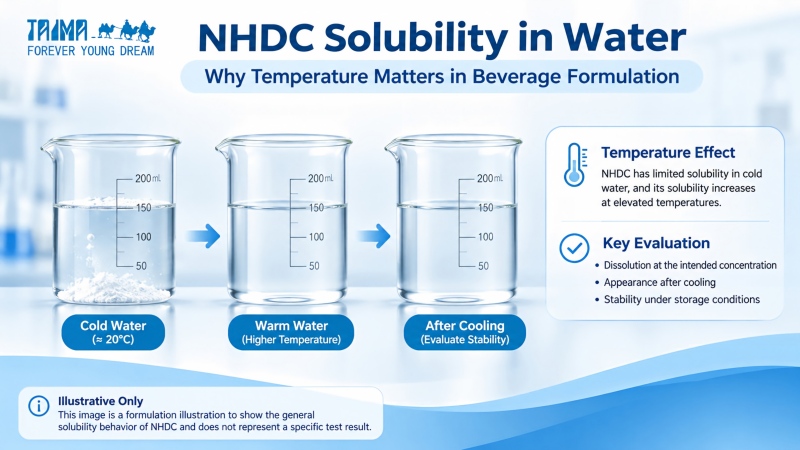
Illustration: General temperature-dependent NHDC solubility and formulation evaluation. Not actual laboratory test results.
Published technical information indicates that NHDC becomes substantially more soluble in water at elevated temperatures.
This means that warm processing conditions may help when preparing NHDC solutions, especially when the intended concentration is difficult to achieve at room temperature.
However, increasing temperature is not automatically necessary for every beverage formulation.
The appropriate dissolution approach depends on the NHDC concentration, available processing conditions, and composition of the finished product.
A solution prepared at elevated temperature may behave differently after cooling.
If the dissolved NHDC concentration exceeds its equilibrium solubility at the lower temperature, precipitation or crystallization may become possible.
This is a general physicochemical consideration, not evidence that NHDC will precipitate in every beverage.
For that reason, formulators should evaluate the solution after it reaches the intended storage temperature.
Not necessarily.
The risk of precipitation depends on the dissolved concentration relative to the solubility limit under the finished product conditions.
EFSA considered NHDC likely to be fully dissolved in aqueous food matrices at the reported industry use levels considered in its 2022 assessment.
This is an important distinction: limited cold-water solubility does not automatically mean that NHDC is unsuitable for beverage applications.
However, concentrated stock solutions and finished beverages should not be treated as equivalent systems.
A concentrated NHDC stock solution may contain substantially more NHDC per unit of water than the final beverage.
As a result, the stock solution may require different dissolution and stability evaluations.
Even if a concentrated solution is clear immediately after preparation, its appearance and stability should be checked under the intended holding conditions.
When the stock solution is subsequently diluted into the finished formulation, its behavior may change again.
Mixing can improve contact between NHDC particles and the liquid, helping the ingredient dissolve more efficiently.
However, mixing alone cannot guarantee dissolution when the target concentration exceeds the solubility limit under the test conditions.
A solution that appears clear during heated preparation should also be evaluated after cooling.
Checking the appearance at the intended holding or storage temperature provides more relevant information about physical stability.
Stock solutions and finished beverages may differ in concentration, pH, ingredient composition, and storage conditions.
Both systems should be assessed according to their intended use.
Visible particles immediately after ingredient addition may indicate incomplete dispersion or slow dissolution.
Persistent undissolved material after suitable mixing and equilibration may indicate that the solubility limit has been approached or exceeded.
Additional evaluation may be required to distinguish these possibilities.
When evaluating NHDC for a liquid formulation, a structured laboratory approach can help identify potential processing and stability issues.
Define the intended NHDC concentration in the finished product and verify that the proposed use complies with applicable regulations.
Document the water temperature, mixing method, ingredient addition sequence, and relevant formulation characteristics.
Check whether visible particles remain during preparation and record the time required to obtain a uniform system.
Visual clarity alone does not confirm complete dissolution or chemical stability.
Bring the formulation to its intended holding or storage temperature and observe any changes in appearance.
Where appropriate, check for sediment, haze, or visible crystals.
Assess the complete beverage formulation rather than relying only on tests conducted in pure water.
Acidity, other ingredients, processing history, and storage conditions may influence the behavior of the finished system.
Repeat observations over a suitable period based on the intended manufacturing and storage requirements.
Where critical to product performance, analytical testing may be needed to confirm the actual dissolved concentration.
NHDC solubility is influenced by temperature, concentration, and formulation conditions.
The most useful approach is not simply to maximize the processing temperature. It is to select conditions appropriate for the desired concentration and confirm performance in the finished product.
Three practical principles are particularly important:
First: Distinguish dissolution rate from equilibrium solubility.
Second: Evaluate concentrated stock solutions separately from finished beverages.
Third: Confirm appearance and physical stability at relevant storage temperatures.
These considerations can help formulators identify potential issues before scaling up production.
TAIMA supplies Neohesperidin Dihydrochalcone (NHDC) 96% for ingredient evaluation and formulation development.
If you are assessing NHDC in a beverage or sweetener system, our team can provide available product specifications and discuss sample requests.
Contact TAIMA with your application, intended market, and required quantity to discuss your ingredient requirements.
TAIMA | Food Ingredients & Sweetening Solutions
Contact us for price, sample, MOQ and OEM support.
✔ Reply within 12 hours
Get Quote on WhatsApp Request SampleWhatsApp: +86 15619038117
Email: alina@taimacn.com