Welcome~Xi'an Taima Biological Engineering Co., Ltd.
+86 029 8111 0978

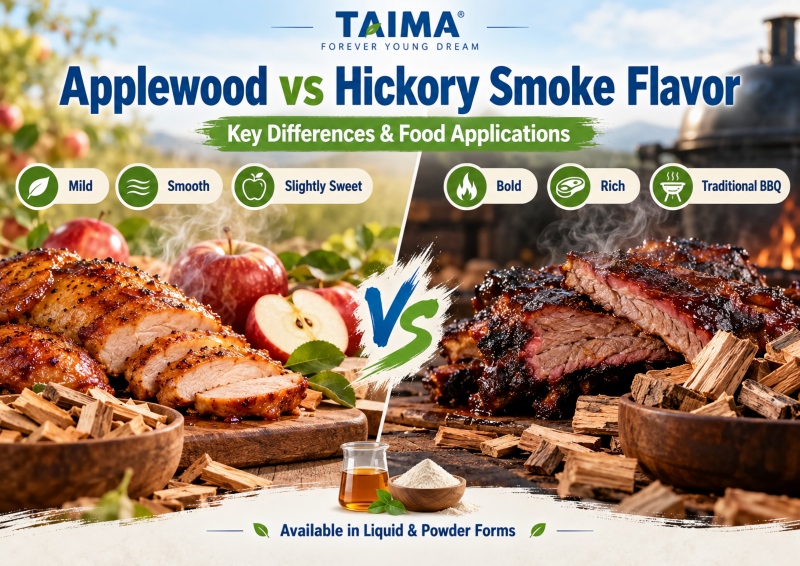
Applewood and Hickory are two recognizable wood-smoke flavor profiles used in barbecue and savory food development. Although both can contribute smoky notes, their typical sensory characteristics are different.
Applewood-style smoke is generally associated with a milder, smoother and slightly sweet impression, while Hickory-style smoke is commonly associated with a stronger, richer and more traditional barbecue character.
For food manufacturers, choosing between these flavor directions involves more than taste alone. The finished food application, flavor format and production process should also be considered.
Applewood Smoke Flavor describes a flavor direction inspired by the characteristic smoke associated with applewood smoking.
It is generally known for a gentle smoke impression with subtle sweetness and delicate fruitwood-like notes. This profile is particularly interesting for products where a balanced smoky character is preferred over a strong, dominant smoke flavor.
Flavor intensity: Mild to moderate
Sensory character: Smooth, gently smoky and slightly sweet
Typical food pairing: Pork, poultry, sausages and mild BBQ sauces
Suitable flavor direction: Balanced savory formulations
In commercial flavor development, Applewood Flavor and general Smoke Flavor may be separate flavor components. Depending on the required sensory profile, they can be evaluated individually or as part of a combined flavor formulation.
The exact sensory result depends on the selected flavor grade and its formulation.
Hickory Smoke Flavor is associated with the bold, rich smoky character traditionally found in American-style barbecue.
Compared with the softer applewood profile, hickory-style smoke is typically more pronounced, making it a useful direction for savory products requiring a stronger barbecue identity.
Flavor intensity: Medium to strong
Sensory character: Rich, woody and pronounced smoky notes
Typical food pairing: BBQ ribs, pork, beef and savory sauces
Suitable flavor direction: Bold barbecue-style formulations
Hickory-style profiles can also be considered for seasoning blends, processed meat products and selected plant-based savory applications.
The main distinction is the desired smoke character rather than a fixed rule about which flavor must be used in a particular food.
Applewood: Typically milder and smoother, providing a more restrained smoky impression.
Hickory: Generally stronger and more pronounced, suitable for creating a classic BBQ-style flavor profile.
Applewood-style profiles are often described as gently sweet with subtle fruitwood-like notes. Hickory-style profiles tend to emphasize rich woody smoke with a more robust savory character.
Applewood may be preferred when the objective is to complement the natural flavor of the food without creating an overly strong smoky impression.
Hickory may be preferred when a more recognizable and assertive barbecue character is required.
These descriptions represent typical flavor directions. Actual commercial flavor products can vary significantly in strength, aroma and composition.
Applewood-style smoke is a useful starting point for pork, chicken and turkey products requiring a gentle smoky character.
Hickory-style smoke can be considered when developing more pronounced barbecue meat flavors.
Flavor Selection: Applewood for milder profiles; Hickory for bolder smoke.
Both applewood and hickory flavor directions can be evaluated in sausages and processed meat applications.
The preferred option depends on the meat formulation, spice system, processing method and target sensory profile.
Flavor Selection: Both, depending on the desired intensity.
Applewood-style profiles can complement barbecue sauces with a smoother, slightly sweet smoke character.
Hickory-style profiles can contribute a more pronounced smoky direction to rich barbecue sauces, glazes and marinades.
Flavor Selection: Choose according to sweetness, smoke intensity and overall sauce profile.
For potato chips, crackers, roasted nuts and dry seasoning blends, either wood-smoke flavor direction may be suitable for evaluation.
Applewood can be considered for a milder seasoning character, while hickory can be explored for stronger barbecue-style products.
Flavor Selection: Match the smoke profile to the finished snack seasoning.
In addition to selecting a flavor profile, food manufacturers need to consider the appropriate physical form for their production process.
Liquid options are generally convenient for compatible wet food formulations, including BBQ sauces, marinades and liquid seasoning systems.
Typical Applications: Sauces, Marinades, Liquid Seasonings and Selected Meat Products.
Powdered flavor options can be considered for dry blending, seasoning powders, snack coatings and spice mixes.
Typical Applications: Potato Chips, Dry Seasonings, Snack Coatings and BBQ Rubs.
For processed meat applications, both formats may be evaluated depending on how the ingredients are introduced into the manufacturing process.
The liquid and powder forms are not necessarily interchangeable. Differences in carriers, concentration, dispersibility and processing performance should be confirmed using the selected product grade.
Yes. Different wood-smoke flavor directions can be evaluated together when a more specific sensory balance is required.
For example, a flavor developer may explore a combination that retains the gentle character associated with applewood while introducing some of the stronger smoky notes associated with hickory.
However, the appropriate combination depends on the actual flavor materials, concentration, formulation and intended food application.
No universal mixing ratio is suitable for every commercial flavor formulation.
Step 1 – Define the Target Flavor
Decide whether the finished product requires a mild or strong smoky character.
Step 2 – Identify the Food Application
Consider meat processing, sauces, marinades, savory snacks or dry seasonings.
Step 3 – Select the Flavor Format
Choose a suitable liquid or powder option according to the production system.
Step 4 – Evaluate Samples
Test the selected flavor in the finished formulation before confirming commercial use.
Generally, applewood-style smoke is milder than hickory-style smoke. However, commercial flavor concentrations and formulations vary.
Applewood is often a useful starting point for a mild smoky chicken profile. Hickory may be selected when a stronger barbecue character is desired.
Both profiles can be evaluated in BBQ sauces and marinades. The selection should be based on the finished sauce's desired sensory characteristics.
Not necessarily. They may differ in concentration, carriers, solubility or dispersibility and application performance.
Yes. Please provide your food application, processing conditions, preferred flavor form and target sensory characteristics. TAIMA can help identify suitable options for evaluation.
For a rich, traditional barbecue flavor direction, explore our Hickory Smoke Flavor.
For applications requiring a mild, applewood-inspired smoky profile, ask TAIMA about our Applewood Smoke Flavor solutions.
We can discuss liquid and powder formats, individual flavor components and suitable flavor combinations according to your production requirements.
Developing a new meat product, BBQ sauce, snack seasoning or savory food formulation?
Contact TAIMA with your target food application, preferred liquid or powder form and desired smoky flavor profile.
Our team can assist with product selection and sample evaluation.
Contact us for price, sample, MOQ and OEM support.
✔ Reply within 12 hours
Get Quote on WhatsApp Request SampleWhatsApp: +86 15619038117
Email: alina@taimacn.com